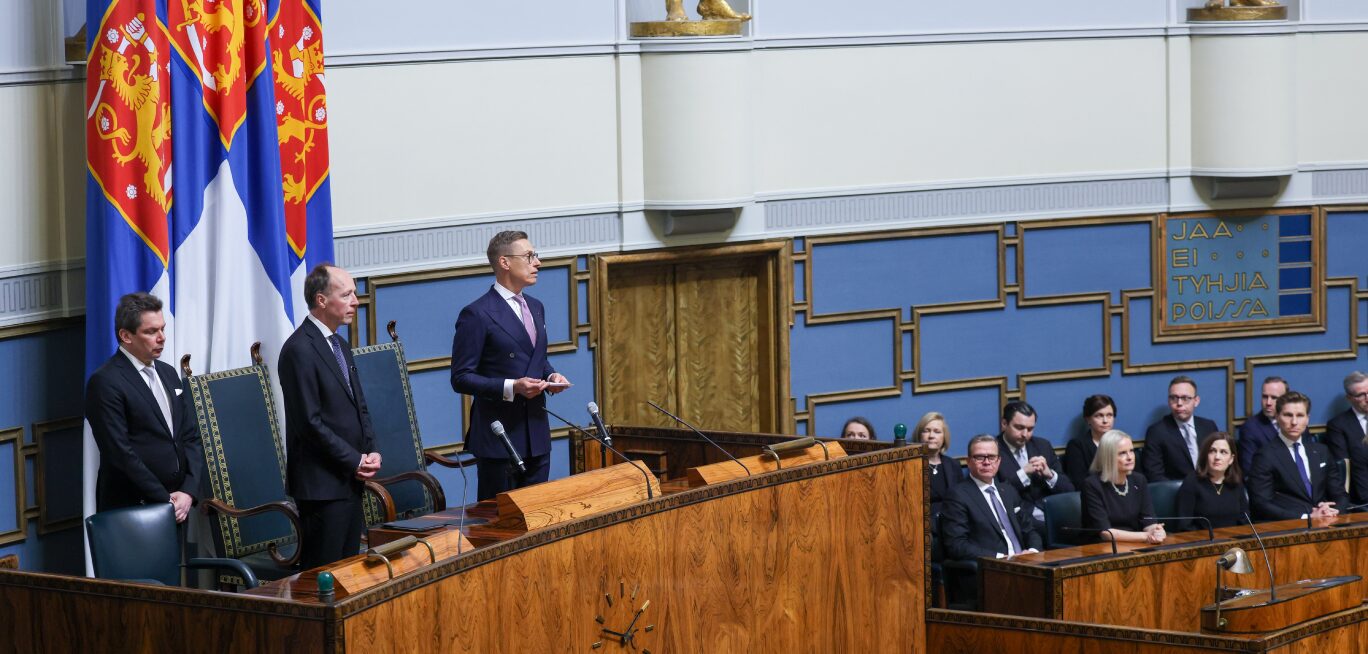
Mr Speaker, honoured representatives of the Finnish nation,
World politics is undergoing a period of transition. The post-Cold War era is over. A new world order is still taking shape.
The past year showed us that Finland knows how to operate in this changing world. We engage with the world as it is and seek to shape it in the direction we believe it should go. We do not merely adjust; we make a difference.
On the chessboard of diplomacy, it’s better to be a player than a pawn. Everything begins with an understanding of what the current transformation in the world is all about and what we can do about it. We must not fear or flee from change; we must be able to influence it. At the same time, we, too, must be able to change. Nostalgia is not a strategy.
***
We are moving towards a world increasingly defined by power and force. This change is gradual, occurring over the long term.
In these times, however, this change manifests to us as events that make it concrete and sudden, even radical.
There are matters we can influence, and matters on which we can speak out. At times, you have to pick your battles.
The beginning of this year stands as evidence of this. We have been working to advance the peace process in Ukraine and to de-escalate the tensions related to Greenland, and issued statements on the situation in Venezuela and the outbreak of violence in Iran.
***
In the world, cooperation, competition and conflicts coexist. We are now living in an era mainly characterised by increasingly fierce competition. We act to ensure that this competition does not escalate into conflict. We act to ensure that cooperation, once again, gains ground.
We have seen how the great powers flexibly employ all the instruments of power available to them. Security is related to technology, trade policy and the economy. This is something we, too, as Europe, must understand and act accordingly. There is no shortage of available tools.
Foreign policy is based on values, interests and power. It is rare for all three to be in perfect harmony. Decisions are made every day in foreign policy. The impacts of the decisions and the balance between them must be carefully weighed. With patience and careful consideration.
***
Three factors are currently most influential in shaping European security. First, the Russian invasion of Ukraine. Second, China’s emergence as a great power. And third, the new foreign and security policy doctrine of the United States. All of these are also shaping the world towards a direction where international relations are increasingly determined by power.
These are the facts. We can react to them either by lamenting them or by taking action. The Finnish way is to take action. That is why we joined NATO. That is why we aim to exert influence within the EU and beyond, as part of Europe. That is why we ensure our defence capability and comprehensive security.
In the midst of this transformation, Europe is emerging as an increasingly independent player. It is taking more responsibility for its security. It is strengthening its defence. It is building the most extensive free trade network in the world. Thanks to our status as a full member of the EU, we have a say in these matters.
***
The United States is an important ally for us. At the same time, we must be honest with ourselves and acknowledge that the United States is changing. What is also changing is the country’s attitude towards its allies and the way it engages in foreign policy. We have watched this happen first-hand over the past year.
The foreign policy of the current US administration is based on an ideology that contradicts our own values, for example, in that it undermines the current international order. Increasingly, it involves operating outside international institutions. In the list of priorities for US foreign policy, Europe ranks behind the Western Hemisphere and the Asia Pacific region.
These are the realities that frame our work every day. We cannot adjust to this transformation in an instant. We will continue to have to make choices. Thanks to our strong bilateral relationship with the United States, we are able to discuss matters directly.
There are areas where we collaborate, such as defence, NATO and the maritime industry. At the same time, there are others on which we openly disagree, such as climate change or attitudes towards international institutions and rules.
Our aim is for Europe to be a more equal and capable partner for the United States in the future. Capability also enables confidence. Unless backed up by power, strong statements ring hollow. At the same time, I would like to remind you that NATO is, by definition, an alliance that unites North America and Europe. Together, we are the strongest defence alliance in the world.
***
There is a reason why Finland actively supports international institutions, such as the UN. International law is equal to the rules of play of the international community.
It has never been a system that has been effectively implemented across all situations. Violations have, in far too many cases, gone unpunished.
But international rules remain the standard by which we assess the actions of states. At times when the great powers have violated these rules, they, too, have usually tried to base their actions on international law as far as possible.
***
Do we, then, still need international rules or institutions? Yes, we do, at least as much as before.
Maintaining the international rules-based system is in Finland’s best interest. A world without rules is a harsh reality for a small country.
This is not a question of idealism, and not even one limited to our values. This is, in fact, about defending our interests. Our interests concern our security, the economy and, ultimately, our everyday lives and standard of living.
The international law-based order also benefits the great powers. Ruthless opportunism may seem attractive. It may seem to deliver quick gains. But it is nothing but a short-sighted pursuit of interests, whose consequences will also be felt by the great powers.
***
Whatever the situation, Finland will defend the sovereignty and territorial integrity of states. These principles are important to us. Respecting them has far-reaching implications for global stability and well-being. Most recently, we were reminded of these principles in connection with Greenland.
Of the ongoing conflicts, the outcome of the war in Ukraine will hold particular national significance for us. Not only has Ukraine been fighting for its own independence, but also for the international rule-based system.
Whether we want it or not, the outcome of the war will have various effects on us, not only in practice but also in principle. It will set the direction for the kind of world we will live in. It will affect the conclusions different countries draw about the perceived benefits of using force. And how high the threshold for starting a war of aggression will be.
Because of this, the outcomes of the war must be based on international law. Because of this, we will continue our support for Ukraine to achieve a fair and lasting peace.
***
The present time is not only defined by external threats. States are also grappling with internal challenges to uphold a strong democracy and the rule of law.
In many countries, the democratic system is being put to the test today, as a result of both external influence and internal polarisation. Some EU countries are facing major challenges related to the development of the rule of law. Thank you to the Government and Parliament for working to provide the European Union with the tools to address these issues.
We are living in a time of instability and fierce confrontation. That is why we need the rule of law to ensure stability, and democracy to address these confrontations together. As legislators, you, the Honourable Members of Parliament, form the core of Finnish democracy together with the executive and judiciary branches of government.
***
Today, Finland is an exceptionally strong democracy and rule-of-law state. International non-governmental organisations rank Finland as the world’s freest country, the world’s second least corrupt country, and the world’s third-strongest rule-of-law country.
Nevertheless, in Finland, too, we must uphold our democratic system every day. And make sure the rule of law is robust enough to withstand difficult times.
Trust in the rule of law and in democracy can also erode. They, too, are at times questioned, even though they are precisely what should bring us together.
***
After all, democracy and the rule of law are what enable us to express different views. They make it possible for competing perspectives to exist in a frame set by common rules. They serve as a barrier to arbitrary rule and oppression.
Democracy also contains a message for our youth. The future is open, and we can influence it. Together, we decide which direction it will take.
In politics, words are turned into actions. The language we use is not irrelevant. Unfortunately, there is no shortage of examples in the world for those who seek to use dismissive and offensive language when referring to other people and entire demographics.
It is often the case these days that those with the most provocative rhetoric receive the most visibility. Provocations are rewarded with attention. Excesses are misinterpreted as courage. Exaggerations as the truth.
***
As the President of the Republic, I consider it essential that we avoid polarisation and build trust in Finnish society. A respectful dialogue lies at the heart of everything. Let’s make sure it stays that way.
During the past year, Parliament has addressed a number of difficult questions while upholding the principles of democracy.
One important decision was the reform of the Act on the Sámi Parliament. The Sámi are the only indigenous people in Finland. The way we treat them reflects us as a society and as a democracy.
The Sámi Truth and Reconciliation Commission published its report in December. I invite you to approach the work of the Commission seriously – and continue on the road towards reconciliation, mutual respect and cooperation.
***
In addition, Parliament has been making difficult decisions to improve Finland’s security in this unstable world. They have concerned Finland’s defence capability, measures to counter hostile influence, and border security.
It is important that we are able to make decisions that strengthen Finland’s security. It is equally important that we reach them together, through careful deliberation and discussion. We share a common goal: Finland’s best interest.
Given the depth and speed of the changes in the international situation, we have agreed with the Prime Minister that Parliament will receive a Government report on changes in the operating environment of foreign and security policy.
The preparation of the report is only just beginning. However, one thing remains clear: value-based realism provides us with the tools to act in this changing world. The goal of Finland’s foreign and security policy will continue to be safeguarding our country’s independence and territorial integrity, avoiding involvement in a military conflict and improving the security and well-being of the people of Finland.
***
Finally, I would like to thank Parliament for its excellent cooperation. In a world marked by turmoil, we need dialogue. For my part, I am ready to continue our dialogue also during the latter part of the parliamentary term.
This is the second, and final, time I will open Parliament during the present parliamentary term. The election year is approaching. Of course, I should not be giving you advice. But based on my experience, you will not win elections by attacking others. Few are interested in the things you oppose. Many are interested in the things you stand for.
Remember, civilised discussions are not only allowed but also required by democracy. You may also disagree. Let’s once again show the world that Finland is a model country of democracy, also during election campaigns.
I congratulate the Speakers on your election. I declare the 2026 Parliament open.
