Why I am optimistic about the future of Europe
Dear Rector Cravinho,
Dear President Van Rompuy,
Excellencies,
Students and faculty members,
Ladies and gentlemen,
Mesdames et messieurs,
Dear friends,
In a 1944 book called “The Children of Light and the Children of Darkness,” Reinhold Niebuhr explores the central tension between democracy and human nature. The Children of Light believe in goodness and moral ideas, but underestimate the power of self-interest. The Children of Darkness understand self-interest and power, but use that understanding cynically.
Niebuhr argues that a democratic society needs both moral purpose and safeguards against the misuse of power. My favourite quote from the book is that “Man’s capacity for justice makes democracy possible, but man’s inclination to injustice makes democracy necessary”. I first read the book as an undergraduate at Furman University in the United States. Fittingly, the book was assigned in a class on American political thought.
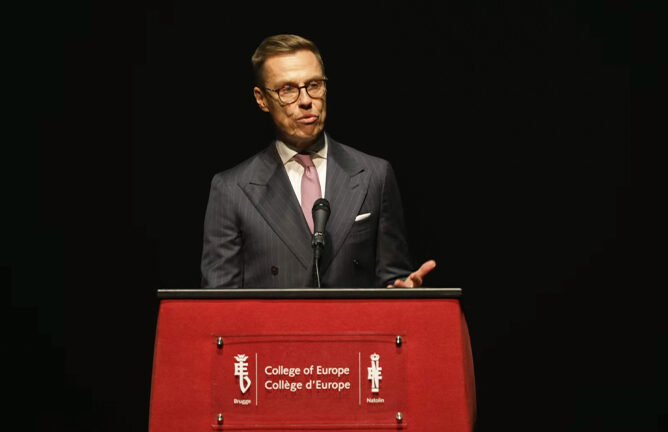
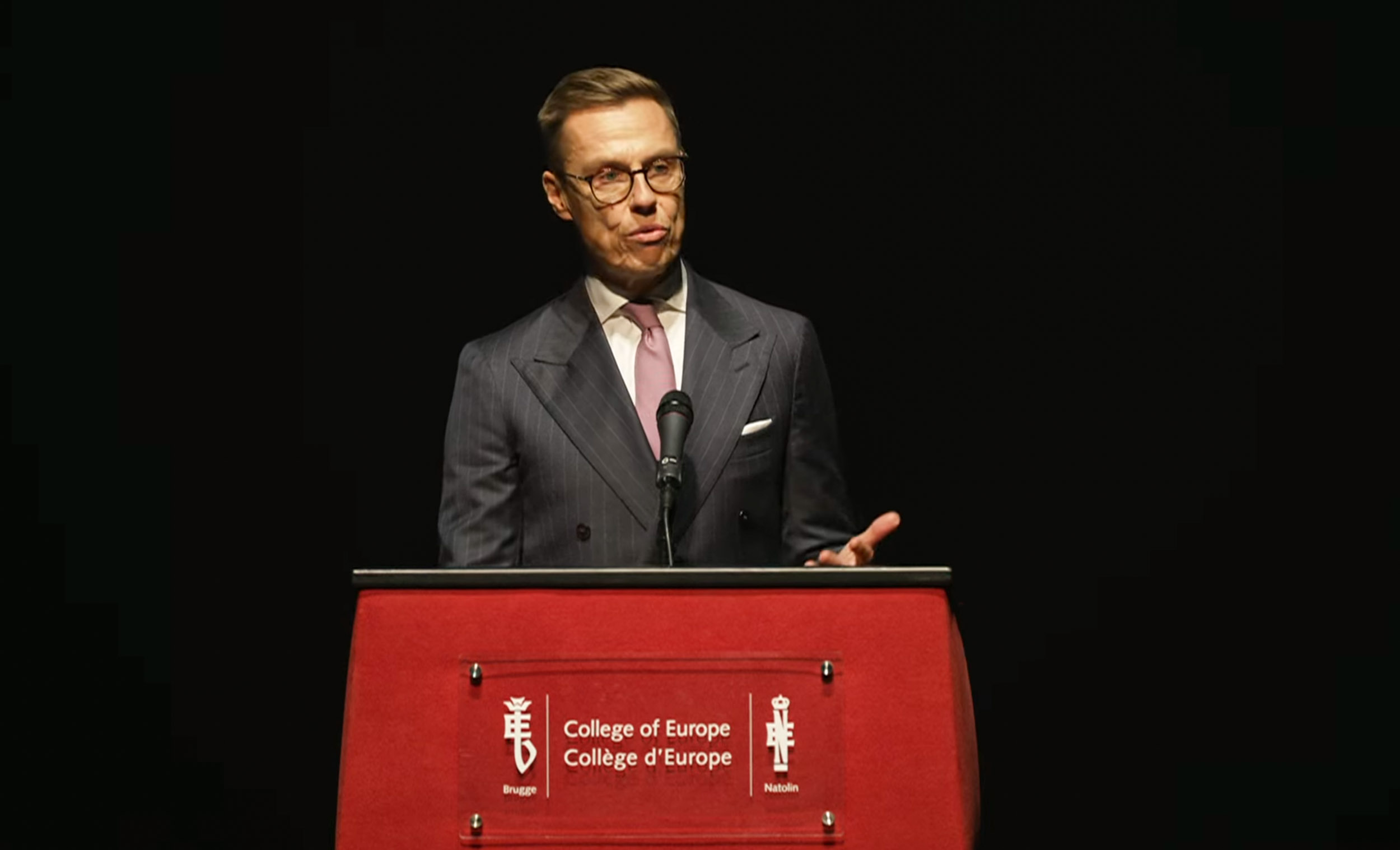
I went back to Niebuhr’s book when I began preparing for this speech. The reason for it was that I wanted to paint a picture of what it was like for me to study here at Bruges some 30 years ago, and reflect on what kind of a world we live in now in 2026, when you begin your studies here.
Don’t get scared about what I am going to say next, because as you will see, my message to you is essentially optimistic. But before I get there, I have to point out an unenviable truth: when I began my studies right after the end of the Cold War, there was plenty of reason to be optimistic. When you begin your studies here today, there are, unfortunately, plenty of reasons to be pessimistic.
In a sense, I began my studies during an Era of Light, and you begin your studies during an Era of Darkness. My job here today is to convince you that there is light at the end of the tunnel. And your job as students is to take the agency that your education will give you and make sure that, when one of your classmates comes back here in 30 years as president, prime minister, or professor, he or she can say that we were able to turn an Era of Darkness back into an Era of Light.
I will therefore structure my speech in three parts. First, the world 30 years ago. Second, the world today. And third, the world 30 years from now. And because we are at the College of Europe, my focus will be on Europe and on you as students.
The world 30 years ago
So, why do I consider myself to have been born into a lucky generation, an era which was dominated by the Children of Light? Well, mainly because things were looking good. When I started studying in the US in 1989, the Berlin Wall fell, Central and Eastern Europe were freed from the shackles of communism, the Soviet Union collapsed in 1991, and yes, Finland, Sweden, and Austria joined the European Union during the year I studied here at Bruges, from 1994 to 1995.
There was this innate feeling of hope and optimism. The Cold War was over. Democracy, capitalism, and freedom had defeated communism, autocracy, and control. Technology was going to liberate the world, even if you had to go to the central square at Bruges to get reception on your Nokia mobile phone. By the way, we did not have email addresses when I studied here in 1995. Internet? Hardly. Social media? No way. Artificial intelligence? No, it was all real.
Be that as it may, many of us believed in Francis Fukuyama’s end-of-history thesis, namely that all of the world’s 200 nation-states would turn towards a combination of democracy, social market economy, and globalization. Now, with the wisdom of hindsight, we can say that it did not happen globally. But, of course, in Europe it did. I am not claiming that Europe is full of optimal liberal democracies or welfare states. Nor am I saying that Europe is perfect. Far from it. But I do think that Europe witnessed a real end-of-history moment.
In the mid-1990s, here at Bruges, I remember reading historical visions of European integration, ranging from Altiero Spinelli to Winston Churchill, from Robert Schuman to Jean Monnet, and from Charles de Gaulle to Margaret Thatcher. I also remember having heated debates about functionalism, neofunctionalism, federalism, institutional intergovernmentalism, neorealism, and all the other “isms” that were trying to explain European integration.
Some of you will love all the theoretical stuff. I certainly did. Others will question their relevance. The only advice I have is to keep an open mind. Whatever you do in life, it is always good to have a grounding in analytical thinking. It will help you in all the practical problems you will solve later in life. The Age of Light, at least in Europe, was all about enlargement, the Euro, institutional change, and democratic reform.
In comparison to today, all the challenges we faced in the EU seemed minor. The major challenges we faced were on policies, power, and finances, not war. Difficult but not existential.
It all became more serious in the aftermath of 9/11. The US operation in Afghanistan was based on a UN mandate recognizing a country’s right to self-defence. The war in Iraq was not. Europe was united on the former, but split on the latter. The difference from a transatlantic perspective is that in those days the United States first went to the UN for a mandate. Failing that, they consulted allies and forged coalitions of the willing. Today, unfortunately, they do neither.
An existential challenge came in the form of the Euro crisis. It was divisive on a north-south axis, but despite difficulties we survived. And became stronger.
The third crisis came in the form of Brexit. The bad news was that the UK amputated a leg without a medical reason for doing so. The good news was that it ended up unifying the EU. Every member state saw that the cost of leaving the Union far outweighed the price of staying in.
My point is that the past 30 years of the EU have been a raving success. Democracy has prevailed, the social market economy was strengthened, and globalization has delivered more or less what it promised. Europe has united. I am not claiming that Europe is a utopia. I am not claiming that populism should not be taken seriously or that immigration is not a challenge. But I am saying that those problems are solvable. I am saying that democracy delivers. It does not deliver perfection. Nothing does. But it does deliver much more than the alternative regimes. In our Era of Light, democracy prevailed.
This is where it becomes time to move to our current Era of Darkness.
The world today
Am I correct in claiming that we live in an Era of Darkness? As always, the glass is probably half empty or half full, depending on how you look at it. But the reality is that there was much more to be optimistic about some 30 years ago. I do want to avoid the triangle of mistakes that we human beings have a tendency to make. We often over-rationalize the past, over-dramatize the present, and therefore underestimate the future. I will try to avoid all of that.
Let’s begin with the good news. Europe is probably more united today than ever before. We feel the security threat from the East, namely Russia, and we feel the political pressure from the West, namely the United States. The world order is changing, and we are trying to find our place in it. In a sense, we are becoming more autonomous and more geopolitical. When the full-scale attack of Russia began in Ukraine, Europe stepped up. Today, Europe provides the bulk of the military, financial, and political support for Ukraine. We continue to support the independence, sovereignty, and territorial integrity of Ukraine.
Sur la scène mondiale, l’Europe continue de défendre l’ordre international libéral. Nous soutenons les institutions, les règles et les normes internationales. Nous croyons en l’État de droit, tant au niveau national qu’international. Nous concluons de nouveaux accords de libre-échange avec des pays et des organisations du monde entier. Nous comprenons mieux les dépendances stratégiques. Nous sommes à l’avant-garde de la lutte contre le changement climatique. Nous sommes le premier continent à avoir commencé à réglementer l’intelligence artificielle. La liste est longue. Il y a de bonnes raisons d’être optimiste quant à l’avenir de l’Europe.
But then I come to the bad news. After the Cold War, there was a sense that the world should be built on multilateral institutions such as the UN, the WTO, the World Bank, and the IMF. There was a feeling that rules matter, and they should be followed. The number of democracies in the world grew and the number of conflicts shrunk. Things were looking good.
Today, the opposite is true. Rules are being broken left, right, and centre. The UN Charter is violated on a daily basis by countries like Russia. Big players like the United States have left key institutions such as the WHO and are imposing sanctions on others such as the ICC. China has a high number of dispute cases in the WTO.
In this new multipolar world order, rules are not respected. We have gone from cooperation to conflict, from managed competition to transactions. It is a dog-eat-dog world. Great power competition has led to the trampling of the rules-based international order.
Interdependence and things that were supposed to bring us together, such as trade, energy, and technology, are used as instruments of power to drive us apart. When I was studying integration, the logic was that integration in one area was supposed to lead to integration in other areas. Interdependencies were good, not bad. Cooperation in pursuit of peace, prosperity and stability was the game in town. This still partly holds in Europe, but on the global arena the opposite seems to be true.
Chokepoints become instruments of war with global ramifications, as we can see in the Strait of Hormuz or the Black Sea. Interdependence is seen as a risk or worse. Trust in international cooperation has been eroded. According to some accounts, there are 65 live conflicts or wars today, more than at any time since the Second World War. The United Nations has been pushed out of peace mediation. Peace deals are transactional and thus short-lived. Global temperatures are rising despite the attempts to control climate change. Nations pick and choose where to cooperate. Some even deny the existence of climate change and continue to lean into fossil fuels. Immigration is seen as a threat to national identity. Humanitarian laws are violated, human dignity assaulted.
We used to be able to say that the three biggest killers of mankind, disease, famine, and wars, have been defeated. That is not true anymore. The light has given way to darkness.
Now, my message to you is simple. In the midst of the cacophony of negative trends, you should, under no circumstance, succumb to pessimism or despair. On the contrary, your job is to pave the way back towards light.
You have agency, and you have to use it. You are the ones who will find the technological solutions for climate change. You are the ones who will develop AI to serve mankind. You are the ones who need to find pathways towards ending conflicts. Yes, I understand that this is a big ask. And yes, you can stand there and point the finger at me and say, “Why are you not doing it?” Believe me, I am trying, and so are many others.
My point is that if you are pessimistic about your own future, Europe’s future, and about the future of the world, it will become a self-fulfilling prophecy. Do not allow that to happen. There is this really silly saying in Finnish: “Pessimisti ei pety. A pessimist will never be disappointed.” Perhaps. But trust me, an optimist will not only live a happier life, but will also make a difference in this world.
There are many different angles you can take in making sure we transition from an Era of Darkness to an Era of Light. I will recommend three – the first one is personal and the two that follow are institutional.
The world 30 years from now
Looking 30 years ahead is never easy. Mostly it is a guessing game. At the same time, I feel that it is always important to try to look ahead. What is behind the corner? Our intelligence services often set out different scenarios. They are useful guidelines for preparation, but I prefer to look at key issues.
In my opening speech of the academic year 2015–2016 here at Bruges, I focused on the pressing issues at the time: the Euro, the refugee crisis, and security. Looking back, I got the first two right, but I would never have believed that the security situation in Europe would be as serious as it turned out to be after Russia’s full-scale invasion of Ukraine in February 2022. The silver lining for Finland was that we joined NATO.
So, let’s look at the most pressing issues you will face in the next 30 years.
Let me begin with the most self-evident: AI. This is where it gets personal. It will change the economy and the way in which you work. It will change politics and the way in which you communicate. It will change academia and the way in which we learn. It will change war and the way in which we conduct it. And it will change science and the way in which we are as human beings.
I asked one of the commercially available AI applications what your patron, Johannes Gutenberg, would have thought about AI. The first answer was rather generic:” I think Johannes Gutenberg would have been absolutely fascinated by AI – and perhaps a little frightened by it, too.” But as always when you begin a conversation with AI it starts developing its answer. I was told that he would recognise the power of spreading knowledge, he would have been worried about who controls information and he might have feared the consequences for human work. We will of course never know what Gutenberg would really have thought about AI. The thing that we understand is that the printing press is a completely different technology because the former is a machine and the latter is software with agency.
When you graduate from Bruges, you will either continue to pursue a further degree or look for a job. If you are doing politics, you will wonder whether we are creating digital democracies or digital dictatorships. If you are studying law, you will probably wonder whether there will be any more lawyers because of AI. If you are doing economics, you will think hard about who will dominate the financial markets of the future: humans or algorithms. None of us knows what the job market will look like in five years, let alone thirty.
The only advice I can give you is to continue to have an open and curious mind. Your life will most probably be much more granular than mine. I have basically had three careers: academia, civil service, and politics. I have been lucky to have been able to oscillate between the three. You will probably have many more careers. You will have to be more flexible than I have been. Prepare for that.
You are not here to memorize theories or case-law. You are here to learn how to think analytically. Use AI as a tool, an instrument, but do not allow it to replace your capacity to think. Think the unthinkable and be prepared to face things that seem unimaginable today.
On AI, there are basically three ways to approach it. You can compete, co-operate, or slow it down. I believe that competition towards some kind of singularity is inevitable, but without co-operation between companies and governments on a regional and global level, it will lead to disaster for mankind as a whole. I do not think that slowing down the development of AI is realistic. The key is to cooperate, to set guardrails, and to make sure that AI will work for the good of humanity in fields such as medicine, climate change, and quality of life in general. If I were you, I would certainly be looking at writing my master’s thesis on something related to AI. In my case, probably the ethics of AI.
The second thing I want to raise about a Europe 30 years from now is enlargement.
Enlargement is the most important foreign policy of the EU. My vision is that in 30 years from now, the European Union will have roughly 40 member countries. That is 20% of the world’s nation states. The membership structures will vary, as they do already today. Not everyone will have the Euro as their currency. But the group will be substantially larger than today. Personally, I would like to see all of the Western Balkans, Ukraine, and Moldova in. I would naturally like to see Iceland, Norway, Switzerland, and the UK in. Canada will be at least an associate member. And for other countries such as Türkiye, Armenia, Azerbaijan, and Georgia, it will depend on how they develop.
Does all of this sound like an ambitious vision, even unrealistic? Perhaps. But again, think the unthinkable. Do you think the founders of the EU thought that we would have 27 member states today? Do you think that leaders thought, even 30 years ago, that the membership of the EU would double? Do you think they thought that we would have a common currency? Or that the EU would be the most integrated area in the world with exclusive competence on trade, competition, customs, and monetary policy? Do you think they thought that the EU would become a major geopolitical actor?
My point is that visions are always big. And when you lay them out 30 years in advance, they often sound unrealistic. Without being too deterministic, it is safe to say that integration in one area leads to pressure to integrate in another. That is the logic of integration. Unforeseen events, big changes in the world order, and yes, crises bring us closer together.
So, expect the EU to deepen and to widen in the next 30 years. Will it be smooth sailing? Of course not. The EU often advances in three phases: crisis, chaos, and suboptimal solutions.
And if you want another suggestion for a master’s thesis, why don’t you go ahead and have a look at my Bruges thesis on differentiated integration, revisit it, criticize it, argue where it got things right and where it got things wrong.
That brings me to my third and final issue for Europe’s place in the world 30 years from now: security. You do not have to have a PhD in international relations to understand that the post-Cold War era is over and the world order is changing. We are witnessing a 1918, 1945, or 1989 moment in world history. And as always, we can get it right, wrong, or somewhere in between.
At the centre of a changing world order is security, not least because of AI where every nation state has to make sure that they are able to deal with the national, international and social threats of AI. Global security will depend on whether we choose, or are forced to choose, multipolar transactionalism or multilateral co-operation. It will also depend on what the big powers – namely the US and China – end up doing. Will they choose co-operation or confrontation?
As a European I am of course mostly concerned about European security. And this is where the post-war (Russia-Ukraine) era will be key. NATO will continue to be the strongest and largest military alliance in the world. It is defensive, not expansive.
The key question for all of us is to create a European security structure which makes sure that Russia does not attack its neighbours again. In order to make that happen we need a process of confidence building measures. Yes, I know, it sounds boring, but that is exactly what security should be. So boring that everyone feels secure enough not to attack a neighbour.
I think the Helsinki Accords of 1975 worked. I think the OSCE was not strong enough to prevent Russian aggression in Georgia in 2008 or Ukraine in 2014 and 2022. But we have to make an effort to get things back on track. Building trust takes time and requires patience. And again, if you are doing politics here at Bruges, why don’t you do your thesis on the future security architecture of Europe.
Conclusion
Let me conclude. I am convinced you will have both a wonderful and challenging year here at the College of Europe. In order to make it, you will have to work hard. In order to enjoy it, you will also want to play hard. The national parties are a good place for that. Some of you will fall in love here. I did. Suzanne and I were voted the most likely couple to get married in our yearbook. We did not let our fellow students down.
My vision for your future and the future of Europe is optimistic. The fact that we are living in an Era of Darkness means that you will have to work harder than I did, so that you can get lead us out of the darkness and towards an Era of Light.
I am sick and tired of all the EU bashing. Every conference I go to, I hear the same old record that Europe has fallen behind the US and China and is doomed. I fundamentally disagree. The pendulum of development swings back and forth. On AI, for instance, Europe has to make sure that it remains relevant in the different parts of the AI stack. For example, energy, infrastructure, semiconductors, compute, data, applications, and so on. And we are.
On the world stage, we have to understand that the world is changing and act accordingly. We should drive values-based realism and a dignified foreign policy.
For all of those who are sceptical about Europe, why don’t you go to your favourite AI application and ask the question “What are the top 10 countries in terms of quality of life?” You might be surprised by the answer. Nine out of ten are European. Your job is to make sure that in thirty years from now, that figure will be 10 out of 10. But when you do that, please allow Finland to be the happiest country in the world for the 39th year running.
Thank you very much, and I wish you a fantastic Bruges experience.