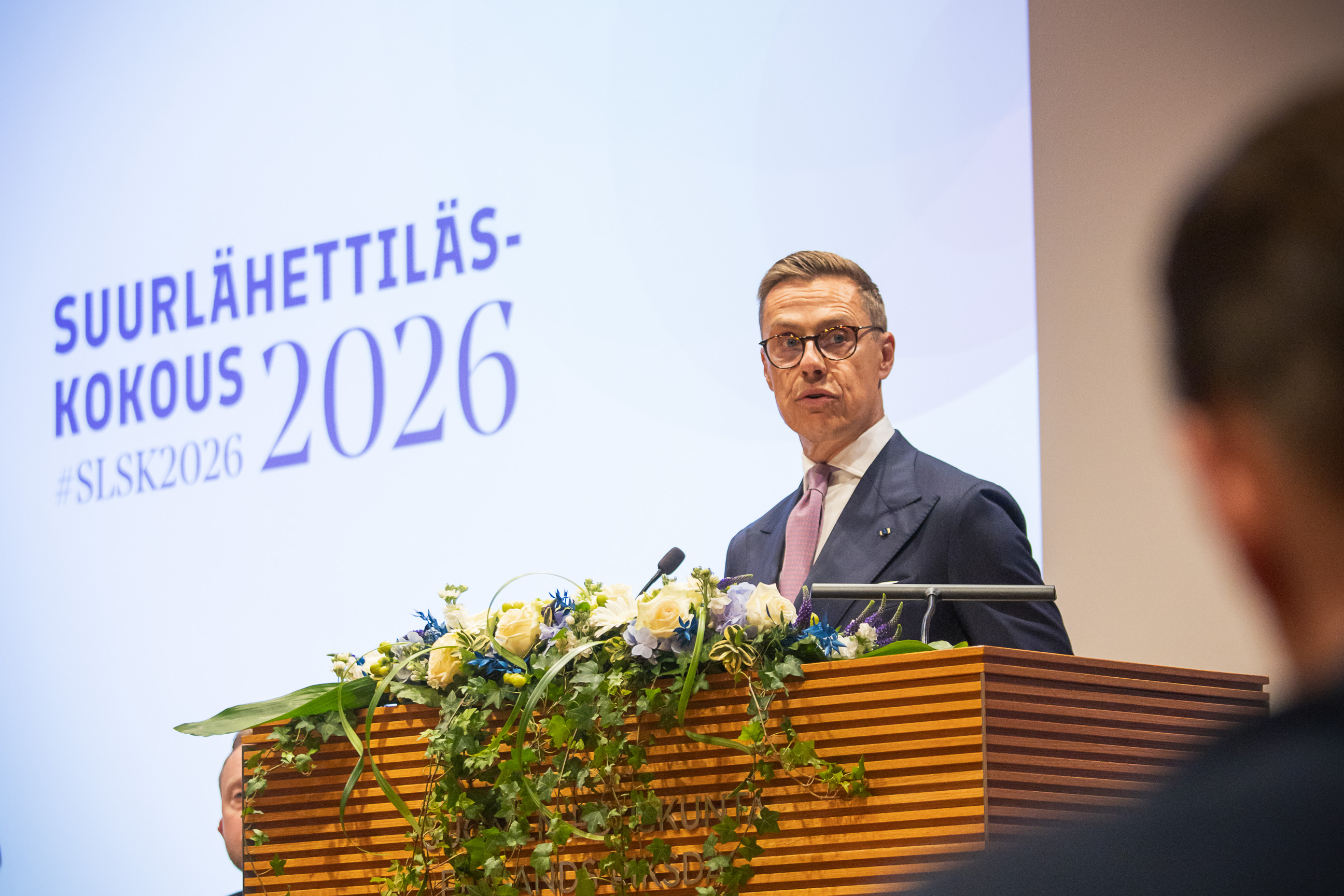
Esteemed Heads of Mission, Ambassadors,
First, let me bring you greetings from Ukraine, where I arrived from this morning. President Zelensky’s message to us was clear: Ukraine needs support for air defence, energy supply, and financing. Much has happened in foreign and security policy since last year’s ambassador’s conference, but supporting Ukraine remains our priority.
***
In my speech last year, I described the playing field of foreign and security policy through values, interests and power. I said that as a small nation, we understand that our power is limited. Therefore, with our actions, we must always aim at maximising our influence.
Today, I would like to talk about the instruments through which we approach this. Three of them in particular: NATO, the European Union and the United Nations. Finland’s foreign policy must be active in these three institutions as well as bilaterally.
***
We are living in a time of profound change. Technology, economy and security are becoming intertwined in a way that will transform the very foundation of the international order. Diplomats do not need to be told that today, everything is foreign and security policy.
Artificial intelligence and other emerging technologies have risen to the forefront of power politics. They have become strategic resources that affect economic competitiveness, political power and defence capabilities. Economic competition has intensified and become increasingly political. Economic and technological dependencies are now security policy issues.
The war in Europe has refocused our attention on security. At the same time, shifts in the policy of the United States force its allies – in Europe, in the Middle East and in the Indopacific – to assume greater responsibility for their own security and that of their regions. The current US administration takes a transactional approach. It does not operate according to the rules of cooperation we have grown accustomed to. We must adapt to this reality while remaining true to our values.
In times like these, it is easy to see small countries as mere bystanders. But Finland cannot afford to sit on the sidelines of history. The ongoing transition involves risks for which we must prepare. Yet it also presents opportunities to strengthen our position and increase our influence. Now is not the time to turn inward. Now is the time to step forward and make a difference.
Our influence is built both on a strong network of bilateral relations and on an active engagement in international organisations. They are the instruments through which we maximise our influence.
The most important of these instruments are NATO, the European Union and the United Nations. They are not just institutions running an endless series of meetings. They are sources of power. Strong international institutions are an advantage for small countries such as Finland.
NATO is the bedrock of our security. It is an alliance that brings together military defence, technological development and industrial capacity. The EU is an economic and geopolitical force that strengthens us. At the UN, we can influence how the ongoing change is managed, and through wise, bold and consistent action we can influence the orientation of the world order.
***
So, let me begin with NATO.
Finland has entered a new era in defence. We are now building our defence together with our allies. Our defence relies on deterrence. In Finland, deterrence is a relatively new and perhaps unfamiliar concept.
The purpose of deterrence is to ensure that conflict never arises. NATO’s deterrence consists of conventional forces and capabilities, missile defence capabilities and nuclear weapons. They are complemented by space and cyber capabilities.
We joined NATO during a period of transition. Some may have thought that NATO membership was the end of the line for Finland, that accession marked the final destination. Of course, it did not. As a member of the Alliance, our influence and engagement were only just beginning. Russia’s invasion of Ukraine triggered a reset to default settings, allowing us to participate in building a renewed Alliance, NATO 3.0.
Every US administration ever since President Truman has called for a more equitable sharing of the burden. The second Trump administration is doing this on turbo speed. The conclusion for Europe is clear: we must assume more responsibility for our own security and defence.
The work to build a more European NATO is already under way. This is a shift towards an era of strategic competition. The Ankara Summit was a milestone, but the process and its destination remain open in many respects. We are building the bridge to the future as we cross it.
We need new European capabilities. But this is not about replacing US capabilities one for one. We also need new thinking and a new strategic culture. We must be able to do two things at once: build strong European agency while preventing transatlantic decoupling. This requires us to identify our shared interests.
We are seeking solutions, in NATO and elsewhere. The role of the EU is growing. It is an enabler, but also a comprehensive actor in its own right. Defence does not exist in a vacuum. It is intrinsically linked to the economy, technology and security. The importance of regional and bilateral cooperation is also increasing. Ultimately, everything we do rests on the Finnish society and its resources – both physical and mental.
Our NATO membership has strengthened our international standing and our security. We are no longer waiting in the sidelines for NATO to become more European. We are actively working to build a stronger more European NATO as part of the Alliance. And because we finally are a member, we are also building a more Finnish NATO.
***
Secondly, Europe.
In 1950, Robert Schuman wrote: “World peace cannot be safeguarded without the making of creative efforts proportionate to the dangers which threaten it.” Another architect of European integration, Jean Monnet, famously said: “Nothing is possible without people, nothing is lasting without institutions.”
After the war, Europe lay in ruins and deep divisions separated its leading nations. Schuman understood that a return to the old ways would not guarantee peace. Something new was needed. Monnet, for his part, recognised that while people create change, institutions sustain it.
These insights and decades of work towards European integration have prevented a new war between the nations of Europe. Today, the question is: how do we defend peace and safeguard all that we have built in a world shaped by power politics? Once again, we need something new, something proportionate to the dangers we face.
Integration is part of the answer. Another part is capacity to act. Europe needs political capacity to act if it is to be a credible actor commensurate with its size. Europe needs economic strength and the ability to use its trade policy tools to safeguard the well-being of its citizens. And it needs defence capabilities to protect itself against outside threats and to strengthen its independence from external actors. All of these measures are now being promoted as a matter of urgency. A more geopolitical Europe has emerged.
The good news is that, in this unstable world, the EU retains its appeal. It may be seen as somewhat boring, but it is also recognised as a stable and reliable actor. Almost every country in Europe either wants to join the Union or draw closer to it. The EU must leverage this.
My argument is that Europe needs flexible integration. An all-or-nothing approach will not work. If we want the EU to be stronger, more resilient and more agile, we need creative efforts that Schuman called for, whether it’s about speedy integration of Ukraine or bringing partners like Norway, the United Kingdom, Canada and Iceland as close to the EU as possible.
History did not end with the end of the Cold War. Nor will the EU ever be complete. We Finns have a choice. We can settle for lamenting Europe’s weaknesses, or we can roll up our sleeves and make Europe stronger. I choose to believe that we are people of action.
***
Thirdly, I would like to talk about the United Nations.
This year’s UN General Assembly High-level Week will be particularly significant. It is important for United Nations, which is striving to maintain its status and credibility, and it is important for Finland, which has just launched its campaign for a seat on the Security Council. The UN stands at a crossroads. The term of the next Secretary-General will determine whether the organisation will grow stronger or lose relevance.
Many of the world leaders gathering in New York have doubts about the UN’s ability to act, and with good reason. Its structures still reflect the Western-centred balance of power that emerged after the Second World War. Its core body, the Security Council, has long been paralysed when it comes to the most crucial issues of war and peace.
The great powers act unilaterally without seeking authorisation from the Security Council. Our neighbour is waging a war that violates the most fundamental principles of the UN Charter. And at a time when there are more conflicts and violence in the world than at any point since the Second World War, the UN is largely absent in mediation efforts.
Over the past year, I have been reading the memoirs of former UN Secretaries-General. While every Secretary-General is inevitably a product of their time, the most successful among them, such as U Thant and Kofi Annan, were active and skilled diplomats who dared to act where others feared to tread. These same qualities are needed in peace mediation, where the UN must reclaim the role set out for it in its Charter.
The next Secretary-General must work with the Member States to restore the credibility of the organisation. We must play an active role in that effort. We cannot simply walk away. Reinforcing the multilateral, rules-based international system is both consistent with our values and in our best interests. The situation is challenging but not insurmountable. Reports of the death of multilateralism are greatly exaggerated.
A world without rules is not an option. Instead, the real contest is over the rules that will shape international relations in the future. This will have a direct impact on Finland and on our interests. For us, the fundamental pillars of international law, including the prohibition of the use of force, territorial integrity and human rights, will remain essential, and we must continue to defend them.
Finland is seeking a seat on the Security Council at a critical moment, as the future direction of the world order is being decided. Through skilful diplomacy, alliance-building and initiative, we can exert influence even as a small, non-permanent member. After all, we have something that is rare in today’s world: a reputation as a bridge-builder and as a competent, consistent and reliable partner.
In many areas, the path to stronger multilateralism may run through plurilateralism. We need to identify opportunities to build flexible coalitions around issues that matter to us. We must not be constrained by convention and bureaucracy. We must pursue cooperation creatively and seek partnerships broadly. Properly used, such ‘coalitions of the willing’ do not undermine multilateral cooperation. They support it and lay the groundwork for making it stronger.
As our campaign for election to the Security Council now begins in earnest, I want you to know that you have my full support in that effort. What is clear is that both the campaign itself and, hopefully, our future membership will require seamless cooperation at home.
***
Ambassadors,
Many of you work with these three institutions: NATO, the EU and the UN. I encourage you to act with courage and initiative. These organisations are tools of our foreign and security policy, and we must use them boldly.
Building and maintaining a strong network of bilateral relationships is just as important. Deep and trusted ties with our closest allies, including the Nordic countries, the Baltic states, the United States and Europe’s leading powers, are the foundation of everything we do. We are already do a great deal. But we can do more.
We also need broader networks, partnerships and markets. The centre of economic and political power is shifting towards the Global South. Finland and the EU must respond accordingly. Finland has perhaps never been as globally connected as it is today. Together, we have worked tirelessly to make this possible, and I would like to thank you for it.
As Russia continues its illegal war of aggression, supporting Ukraine remains a key priority of our foreign and security policy. It is both morally right and in our national interest. As for NATO and the EU, our position is clear: Ukraine has chosen a European and transatlantic future and has expressed its will to join the EU and NATO, which is a goal that Finland supports.
Russia is and will remain our neighbour. When the war ends, we will begin to redefine our relationship as neighbours from a new position. We are no longer alone, but part of the world’s strongest military alliance. The border between Finland and Russia has become a border between NATO and Russia. This need not mean an iron curtain. I hope the time will come when we can once again have a functioning relationship as neighbours. As I have often said, Russia’s own actions will determine how our relationship evolves.
***
Dear friends,
If I were to define the core of our foreign and security policy here and now, I would highlight three priorities. Safeguarding our national interests and security. Bearing our European responsibility. Exercising global influence. This requires an active foreign policy.
We must not turn in on ourselves and focus solely on our own security. Our security cannot exist without European security. We must build a stronger and more secure Europe.
We must not be a passive member of Europe. We must help Europe grow stronger, both in NATO and in the European Union.
We must not stand by and watch the international system erode. We must actively defend it and help renew it.
In all this, the Foreign Ministry plays a key role. Your work delivers security, influence and competitiveness. As has been noted here today, diplomacy is a form of national defence.
I can understand that, given the resources available, you may feel you are being asked to do more with less. That is simply not possible. Success is not about quantity, but impact. Focus on where you can make the greatest difference.
Your expertise is valuable. Do not settle for being passive bystanders or mere executors. Be bold. See the big picture and make your thoughts known. Be active. Bring people together. Take initiative. Share Finnish expertise. Have an impact both abroad and at home. And when you find a way forward, pursue it with determination.
Finland has been ranked as the happiest country in the world for the ninth year running. More than 2,000 years ago, Thucydides knew that the secret of happiness is freedom and the secret of freedom is courage. We need courage to defend our interests, to take our place at the table, to speak up, and to exert influence. That is our job. Mine and yours.
In conclusion, I would like to thank Minister for Foreign Affairs Elina Valtonen and Minister for Foreign Trade and Development Ville Tavio for their excellent cooperation during this government term. I would also like to thank Permanent State Secretary Jukka Salovaara for his outstanding work over these critical past few years and wish him every success in his important new role. At the same time, I would like to congratulate the incoming Permanent State Secretary, Tuomas Tapio. The Ministry for Foreign Affairs will remain in good hands.
Thank you.
