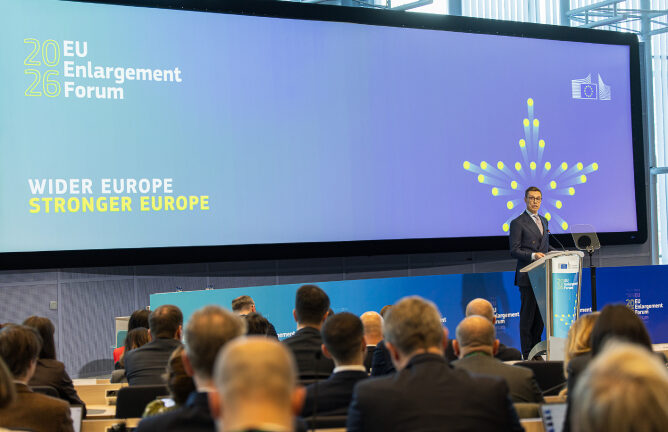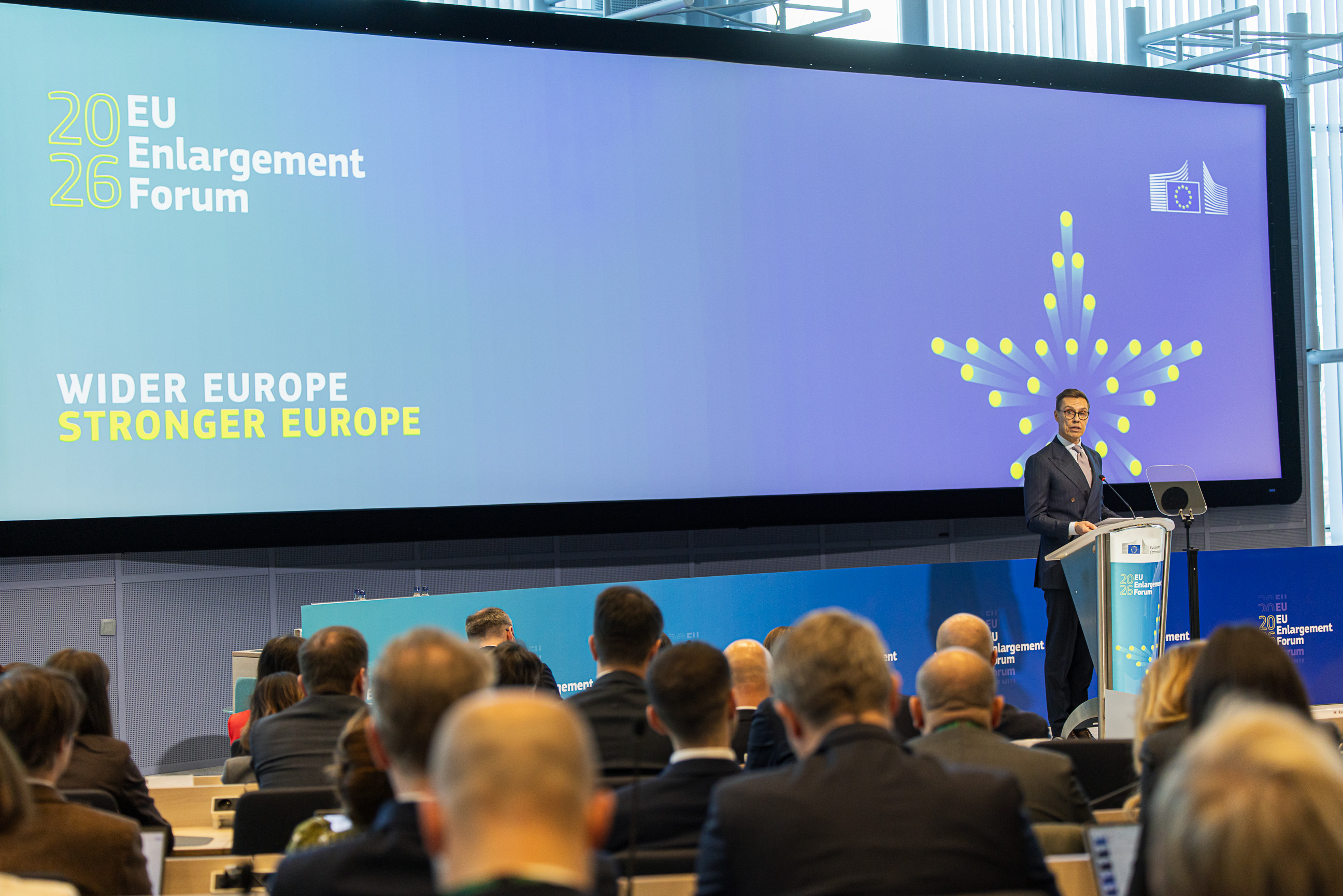
Check against delivery
Ladies and Gentlemen, dear friends,
Every generation of Europeans faces a defining task. For the generation that gathered at the Helsinki European Council in 1999, the task was clear: to overcome the divisions of the Cold War and reunite Europe.
I remember that time well. I was serving in Brussels at Finland’s Permanent Representation as deputy Antici. What I learned has stayed with me: Enlargement is not a technical exercise about negotiating chapters or institutional reform. It is a strategic choice about the future shape of our continent.
The Helsinki European Council opened the door to the largest enlargement process the Union had ever undertaken. Accession negotiations were launched with six candidate countries and Türkiye was granted candidate status for the first time. I remember it vividly because I was there as a notetaker in the Antici room.
The decisions launched in Helsinki transformed Europe. They expanded the area of democracy, prosperity and security. They anchored key countries in the east of the continent firmly in the European family. They made Europe stronger.
Today, we face a similar moment. Sure, the circumstances are different. But the strategic challenge is of the same magnitude. How do we strengthen Europe in a world of great power competition, war on our continent, technological rivalry and growing uncertainty?
My answer is simple: Enlargement. We should make good use of the most successful foreign policy tool the European Union has ever possessed.
No other EU policy has transformed our continent more effectively. No other policy has exported stability or projected European values, prosperity and security more successfully.
Enlargement should not be viewed merely as a technical process. It is a strategic, geopolitical instrument. And yes, power is also about size. The bigger the EU, the more global power we can project.
***
Before diving deeper into enlargement, let me make a broader point about Europe.
I am getting tired of Europe-bashing. For years we have been told that Europe is falling behind, losing relevance and drifting towards irrelevance in a world shaped by American and Chinese power.
Yet, when countries around the world look for stability, predictability, the rule of law, high living standards, safety and trusted partners, they continue to turn to Europe. We top the charts in all of these areas.
And after the shock of Russia launching its full-scale war, Europe has strengthened militarily and emerged as a genuine geopolitical actor.
Europe’s defence awakening is one of the most significant geopolitical shifts of recent years. Defence spending is rising across the continent. Defence industries are expanding, companies are attracting investment and developing new capabilities. Governments and companies are working together to strengthen Europe’s defence and to reduce fragmentation.
Military strength leads to political strength. A Europe capable of defending itself is a Europe whose voice carries weight in the world. It is also a Europe that brings security to its neighbourhood, as illustrated by the EU’s strong support to Ukraine.
At the same time, countries around the world are reassessing their strategic dependencies. The idea that interdependence would automatically guarantee peace is fading. Trade, technology, energy, finance and supply chains have all become instruments of power.
In this environment, Europe offers something increasingly rare. Not only economic opportunity but also predictability, rule of law and stability.
As a result, countries large and small are seeking closer ties with Europe. It is not a coincidence that the EU has now been able to finalize trade agreements with partners such as Mercosur, India and Australia.
The EU has pull. We have strategic gravity. Yes, we may sometimes be seen as bureaucratic and boring. But in today’s unpredictable world, boring is good.
***
Let me come back to enlargement.
I will readily admit that I am an EU nerd. As a young academic, I spent far too much time studying the nooks and crannies of the Union. In my PhD, I defined three forms of flexible integration: multi-speed, variable geometry, and à la carte.
I won’t go into detail of my PhD but I will say that at the time, these debates were considered highly technical. Today, they are more mainstream. The Commission’s vision of gradual integration is a welcome step towards a Union, where candidates could begin sharing in the benefits and responsibilities of European integration before accession.
Of course, enlargement must remain merit-based. Countries join when they fulfil the criteria. The Copenhagen criteria matter. The EU is and must remain a community of values. Our core principles must never be compromised. And in this geopolitical environment, it is important for applicant countries to comply with the EU’s common foreign and security policy.
But we must also recognize that the geopolitical clock is ticking faster than the accession process. In today’s world, an all-or-nothing approach will not work. We need a more sophisticated approach.
A lot has changed in the nearly three decades after I defended my dissertation. But I haven’t changed my mind. I still think the EU needs to embrace more flexible and gradual integration. Not everyone has to do the same thing at the same time. Europe should not advance only through the lowest common denominator. Willing and able should be able to advance. Cooperation should always be open for others to join.
The challenge is no longer simply how Europe governs itself. The challenge is how we organize a growing group of countries that wish to be part of our political, economic and security space.
***
Let us begin in the East.
The picture is clear. Ukraine and Moldova belong in Europe. Their accession should remain merit-based, but when reforms are delivered, Europe must respond with speed and determination.
The strategic case is overwhelming. Ukraine is not only defending its own independence and sovereignty. It is defending the very principles on which European security rests. It has the strongest armed forces on the continent and the latest, battlefield-tested technologies. We need Ukraine as a partner in security and defence. Ukraine’s EU membership is not only a security guarantee, but also a deterrence for Europe as a whole.
At the same time, we should not force candidates to wait passively. We should explore possibilities for gradual integration. Participation in EU bodies and summits increases alignment and the sense of belonging. Access to parts of the single market, different policies and programs brings tangible benefits and accelerates reform.
These steps should not be viewed as substitutes to full membership. On the contrary, they should serve as an accelerator and stepping stone towards it. Every step that strengthens Ukraine strengthens Europe. The same applies to Moldova.
To the South, I am glad to note we are regaining momentum in the Western Balkans. Montenegro is on the path of becoming the next EU Member State. I hope Montenegro’s example inspires others in the neighbourhood: Reform has been met with progress.
We should also speak openly about Türkiye, a major European security actor and an indispensable NATO ally. Yes, we sometimes differ in values. But more often than not, our interests are aligned. In areas where that happens, cooperation can and should deepen.
In the North, we also have indispensable partners.
The recent referendum in Iceland demonstrated that a majority of Icelanders do not currently wish to resume accession negotiations with the European Union. We respect that democratic choice.
But membership is not the only measure of closeness. With Iceland and Norway, our objective should be straightforward: As close as possible. The Nordic and Arctic region is becoming one strategic space. We need close cooperation in energy, Arctic affairs, innovation, resilience and defence industry.
To the West, we should adopt the same strategic mindset.
Self-evidently, leaving the EU is a bad thing both politically and economically for a country that does it. I think Brexit has proved that to be true. We will work with the UK and keep all options open, including deeper strategic partnership and possible future membership. Personally, I admire Prime Minister Burnham’s courage to take this bull by the horns.
Today, as we are facing a war in Europe, a fact remains: Europe needs more Britain. And Britain needs more Europe. The UK is a trusted partner in defence and security, but also in industry and economic security. We must stop punishing the UK for Brexit.
So, I suggest that we turn a new page. Let’s not concentrate on the past and revisit old arguments. Instead, let’s focus on the future. Let’s build practical cooperation in defence and military mobility, intelligence, technology, research, and industrial capacity.
The logic should again be straightforward: As close as possible. And see where it takes us. I would be the first to welcome the UK back with open arms.
As for Canada, the same ambition applies.
Canada is not a European country. But it is unquestionably part of the Euro-Atlantic strategic community. It shares our values, democratic traditions and security interests.
Therefore, I think it is good and right that the Commission is thinking more ambitiously about new forms of association. As the Commission President Ursula von der Leyen has described, the aim should be to build something closer to membership than anything we have done before.
There should be no impediment for countries such as Norway, Iceland, the UK and Canada to opt-in to cooperation in areas such as security, space or the Arctic.
The world is changing. Our institutional imagination should evolve with it.
***
Ladies and Gentlemen,
The debate about enlargement is often framed as a debate about expanding the European Union. I believe it is something much bigger. This is about Europe and our whole strategic community.
Some countries will become full members. Others will participate through different forms of integration and partnership. But all can contribute to the same strategic objective: A stronger, safer and more influential Europe.
The leaders who met in Helsinki in 1999 understood that history occasionally presents moments that shape generations. They seized that moment.
Now history presents another. Europe has awakened. Europe is rearming. Europe has become a geopolitical actor.
We need to have a vision and confidence to match that reality. I call on both the EU member states and candidate countries to think big.
Enlargement, combined with creative flexible and gradual integration, should once again become one of the central strategic projects of our time.
Thank you.